home |
science club |
tuxtalk |
photos |
toolbox |
avr microcontroller & DIY electronics |
e-cards |
familyhistory

sand dollars
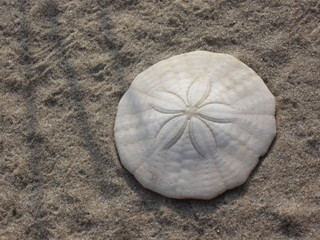
My first encounter with sand dollars
I must admit that I had never heard of sand dollars before encountering them on Iles de la Madeleine.
One day there at the beach two women we were passing asked us if we had found any sand dollars. Sand dollars? We quickly found out that sand dollars are marine animals belonging to a group called echinoderms that are related to sea urchins and the sand dollars you usually find on the beach are really their skeleton or dead shell which is called a "test". They look very pretty and to our surprise there was also a collection of beautiful exemplars in our rental cottage. For the rest of our vacation we now started searching for sand dollars and really could find a few really nice ones. They are very fragile though and most lying around on the beach are broken.
Why are they called sand dollars?
They are called sand dollars because they really look like a sand coin and some even have the size of a dollar even though they come in many different sizes.
They have the sand part in their name because they partly bury themselves under the sand in the sea water for protection.
Where do they live
Sand dollars live in sandy or muddy areas of the ocean, typically at depths between 10 and 30 meters, though they can be found as deep as 90 meters in some areas. They're most commonly found along coastal regions, especially in places with gentle wave action. You can find them on the ocean floor or just below the surface of the sand.
They live in the Pacific, the Atlantic and the Indian Ocean.
In the Atlantic Ocean they are found along the eastern coast of the United States and Canada, parts of the Caribbean, and other parts of Europe and Africa.
In the Pacific Ocean they are quite common along the coasts of North and South America, particularly the western coasts of the United States, Canada and Mexico and down through Central America.
They are also found in some areas of the Indian Ocean, especially around tropical coastal regions.
They thrive in sandy, soft-bottomed environments and live mainly on the ocean floor.
They need salty water and can't survive in fresh water.
Are there different species of sand dollars and how are they different?
There are different species of sand dollars! While they all share certain characteristics (like being flat, disc-shaped, and part of the echinoderm family), different species of sand dollars vary in size, shape, color, and habitat preferences.
The Common Sand Dollar (echinarachnius parma) is found in the Atlantic Ocean, particularly along the eastern coast of North America, including parts of the Caribbean and Europe. This species tends to have a more rounded shape, with a pattern of five petal-like grooves on its surface. They are often found buried in sandy or muddy sediments. That's probably the sand dollars we saw.
The Pacific Sand Dollar (dendraster excentricus) is found along the Pacific coast of North America, particularly from California to Alaska. They are typically white or light-colored when washed up on shore.
There are more species like the Rosy Sand Dollar (Clypeaster rosaceu) or the Black Sand Dollar (Peronella lesueuri) etc. Rosy Sand Dollar are found in the Caribbean Sea and parts of the Gulf of Mexico and are known for their rosy or pinkish color. The Black Sand Dollar is found around the coasts of Australia and the Indo-Pacific region and has a darker color probably because it lives in deeper, murkier waters.
The species are different in color (from white, light brown, and pink to darker shades like purple or black), size (ranging from 3 to 12cm), shape (while they are all round some have more pronounced edges or a smoother, more rounded surface) and habitat (from shallow coastal waters to deeper offshore areas).
What do they eat?
Sand dollars are primarily filter feeders. They feed on microscopic plankton, small invertebrates, and detritus that pass through the water. They use their tiny, hair-like structures (called cilia) to sweep food particles toward their mouths. The cilia work much like a net, collecting plankton that drifts by.
How do they eat?
Sand dollars are bottom feeders, meaning they eat tiny bits of food found in the sand or floating in the water. They use their tiny spines and tube feet (like soft little brushes and conveyor belts) to collect plankton, algae, detritus (tiny bits of dead plants and anmials) and microorganisms. They gather this from the water flowing over them and the sand they sift through.
Once they catch something to eat, they pass them along grooves on their underside using cilia (tiny beating hairs) and spines. They have spines all over their body and most are used for walking but the ones around their mouth help them trap and get food into their mouth. The food moves down toward the center of the bottom side, where the mouth is. Then they use their Aristotle's lantern which is a complex, five-part jaw structure made of hard plates and tiny teeth to chew on their food. Their Aristotle's lantern can also grind particles and break down algae and other tough stuff.
Who are their predators or who eats them?
Sand dollars are a tasty treat for a range of predators, from sea stars and fish to birds and crabs!
Sea stars (or starfish), especially crown-of-thorns starfish are their number one predator. Sea stars can use their tube feet to pry open the hard plates on the sand dollar's body and then extend their stomachs out to digest the soft parts inside.
Skates (cartilaginous fish related to rays) have strong jaws that can crush the sand dollar's shell (called test), allowing them to eat the soft parts.
Other predatory fish like triggerfish or wrasse have been known to nibble on sand dollars.
Crabs, particularly cancer crabs and ghost crabs, will sometimes scavenge or actively hunt sand dollars. They may dig them out of the sand or find them when they are exposed to the surface during low tide.
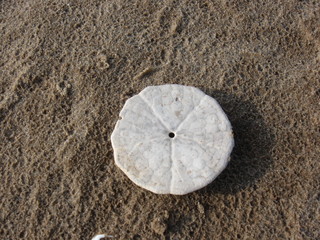
Some snails are also known to feed on sand dollars. Some snails can drill a hole through the sand dollar's hard shell using their radula (a rasping, tongue-like organ) and enzymes. They then eat the soft inside.
Some seabirds, like gulls or plovers, are known to peck at sand dollars, especially those that are washed ashore or exposed. These birds will eat the soft tissue of the sand dollar, particularly when it is dead or weakened.
Other marine invertebrates like octopuses and lobsters may prey on sand dollars when the opportunity arises. Octopuses, with their dexterous arms, can manipulate and pry open sand dollars to access their soft parts.
Humans are usually not eating sand dollars but despite it being forbidden in most places sometimes collect sand dollars that are alive killing them in the process.
How do they protect themselves
When they sense danger (like a sea star approaching), sand dollars use their spines and cilia to rapidly dig into the sand and hide. Young sand dollars burrow even faster than adults because they are more vulnerable.
Their flat shape and natural colors (dark purple, brown, or gray) help them blend in with the ocean floor.
When buried, only a small part of their body is exposed, making it harder for predators to find them.
If young sand dollars sense a lot of predators nearby, they can slow their growth and even shrink by reabsorbing parts of their skeleton. Smaller sand dollars are harder to detect and can burrow deeper into the sand.
Sometimes a young sand dollar will even clone itself.
In areas with more predators, sand dollars develop a thicker, stronger skeleton (test) to make it harder for sea snails or skates to crush them.
Some species release a yellow or brown pigment when touched, which might deter predators. The chemical makeup of their bodies also makes them less tasty to some predators.
Sand dollars are slow, but if they feel a sea star's touch, they stand upright on their edge and "dance" away using their spines! This tilting motion helps them move faster than usual, which can be just enough to escape.
If a predator tries to attack, a sand dollar might break off small pieces of its body to escape-similar to how some lizards drop their tails! That's fragmenting under stress as a kast resort!
This doesn't always save them, but it can give them a chance to survive.
How do they swim/move in the water?
While sand dollars aren't great swimmers, they can move across the ocean floor. When disturbed, they can use their spines and tube feet to inch along, and they can flip over if they're upside down.
They have many little spines that kind of look like hair all over their body. Many of these spines are their tiny legs which they use for moving along in the water and to bury themselves into the sand.
Some species have the ability to "swim" short distances by moving their spines in a wave-like motion, which helps them propel themselves upward or sideways in the water. However, they are generally slow movers and rely on currents to carry them around.
How are they born and how long do they live?
Sand dollars reproduce by spawning, where males and females release eggs and sperm into the water, and fertilization happens externally. Once the larvae hatch, they are left to develop on their own without any parental care.
Most live between 6 to 10 years.
How do they perceive their environment? What senses do they have?
Sand dollars, like other echinoderms, perceive their environment primarily through their simple nervous system and sensory structures. Although they don't have a brain or sophisticated sense organs like eyes or ears, they can still sense and respond to environmental cues.
Touch: Sand dollars can perceive physical touch and vibrations through their spines, tube feet, and the sensory cells located in their body. These tactile responses help them detect changes in their immediate surroundings, such as the presence of predators, changes in water movement, or obstacles.
Sensitivity to light: Sand dollars do not have eyes but they are sensitive to light and darkness. They have specialized light-sensitive cells on their body surface, especially on the upper side of their exoskeleton.
These cells allow them to sense the presence of light and adjust their behavior accordingly.
Some scientists think that they can sense light through their entire body and are essentially acting as a whole-body photoreceptor.
Hearing: There is no evidence that sand dollars have ears or a sense of hearing in the way that vertebrates or even some invertebrates do. They lack the necessary biological structures for detecting sound waves traveling through the water.
Smell and Taste: They have chemical sensitivity which is similar to smell and taste perception: Sand dollars can sense chemical cues in the water, a trait shared with many marine animals. These chemical cues help them locate food, detect predators, and assess the surrounding environment.
Mechanoreceptors: Sand dollars have mechanoreceptors (sensors that detect movement and pressure) that help them feel changes in water flow. If a strong current is present, they may tilt their body or adjust their position to avoid being swept away. Some species even stand upright in the sand to catch more food particles when water conditions are right.
Gravity & Orientation - They have a water vascular system and statocysts (balance organs) that help them determine up from down, so they can properly burrow into the sand.
Sand dollars are sensitive to changes in water currents and hydrodynamic pressure. Their water vascular system (a network of fluid-filled canals) helps them detect the direction and flow of water, which is crucial for feeding and movement.
Pheromone Detection in Larvae: Sand dollar larvae have the ability to sense pheromones released by adult sand dollars. This triggers their metamorphosis and helps them settle in suitable adult habitats. This form of long-distance chemical signaling for developmental cues isn't a sense we directly experience in the same way.
Sand dollars can only survive for a few minutes out of the water. If the sun shines on them they start to bury themselves in the sand.
Do they breathe?
They don't have lungs or gills but are using their petaloids, which are the flower-like patterns on their upper surface. These petaloids contain specialized tube feet that are not used for movement but for respiration. So they rely on diffusion (oxygen moving from high to low concentration) through their tube feet for breathing. The petaloids provide a large surface area, making gas exchange quite efficient.
Since sand dollars often burrow into the sand, they rely on tiny movements to create water flow around them, ensuring they get enough oxygen. They use their spines and cilia (tiny hair-like structures) to move water over the petaloid area, increasing oxygen absorption.
Group living
Sand dollars tend to live in groups, sometimes thousands together, forming what scientists call a "bed" of sand dollars. This grouping helps them with survival-more bodies = better chance of avoiding predators and stirring up food.
As they are very different from us, they don't have a backbone, they don't have a brain etc. they also communicate in different ways with each other than we do.
They sense each other chemically, for example if one sand dollar is injured, nearby individuals may sense the chemicals it releases and burrow deeper to avoid danger.
They also sense each others presents. Baby sand dollars (larvae) use chemical signals to find each other in the ocean. When they are a little bit older and it's time to settle down, they often choose places where other sand dollars are already living.
Unfortunately scientists don't know much about how they communiate with each other yet. So far it seems that they don't show complex social behaviors but who knows, maybe it is discovered in a couple years.
How do they learn or adapt themselves to their environment?
While lacking complex learning, sand dollars exhibit behavioral plasticity, which means they can adjust their behavior in response to changing environmental conditions. This isn't necessarily "learning" in the cognitive sense, but rather a flexible way of interacting with their surroundings. For example:
They can adjust their burrowing depth based on sediment type, water currents, and the presence of predators.
They can orient themselves in the sand to optimize feeding based on water flow and food availability. Some species even stand vertically in the sand to catch food.
They can adjust the movement of their spines and cilia to efficiently capture and transport different types of food particles.
In case of food shortages they react as individuals and not as a group by increasing foraging, conserving energy, and potentially adjusting their feeding methods.
Do they need sleep?
They don't sleep like humans. Sleep helps animals with brains process information, reset neurons, and store memories but sand dollars don't have a brain. Sand dollars only have a very simple nervous system consisting of a nerve ring around their mouth and radial nerves extending outwards. So they don't need periods of inactivity for neural restoration. They also don't close their eyes (they don't have any!).
But there are times when sand dollars remain relatively still, either lying flat on the sand or partially buried. This period of reduced movement could be analogous to a resting state, allowing them to conserve energy.
Some studies suggest that they have a circadian rhythm (a daily rhythm) because they seem to have activity patterns that shift over a 24-hour cycle.
They might be more active at night to avoid predators and rest quietly in the sand during the day.
How ours and their body are different
As we have seen already as a nervous system they don't have a brain and spinal cord but a nerve ring and radial nerves.
For respiration they don't have lungs but tube feet in petaloids for gas exchange.
For circulation instead of a heart and blood vessels they have a water vascular system. They also don't have red blood cells (no blood at all) but use sea water and hydraulic pressure.
To eat and process food they actually have a stomach and an intestine. Their mouth has an Aristotle's lantern which is a complex, five-part jaw structure made of hard plates and tiny teeth .
They also don't have kidneys.
And they also don't have an internal skeleton but a hard external shell made of calcium carbonate called test.
What is their role in the ecosystem
Like other animals one of their roles is as a food source for other animals. But apart from that their feeding habits help keep the water and sand cleaner by consuming organic matter and microorganisms. This contributes to the overall health of the ecosystem.
By consuming and processing organic matter, they play a role in nutrient cycling within the marine environment.
Their interactions with the sediment can create microhabitats for other small marine organisms.
Their burrowing activities can help stabilize the sediment on the ocean floor.
The health and presence of sand dollar populations can be an indicator of the overall health of the marine environment, as they can be sensitive to pollution and changes in habitat quality.
How different do sand dollars look that are still alive from the skeletons that you usually find on the beach?
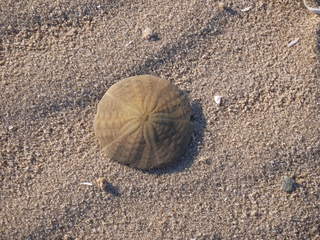
Instead of being white, live sand dollars are typically dark in color, ranging from gray, brown, reddish-brown, to deep purple or even bluish. The exact shade can vary depending on the species and their recent activity (e.g. if they've been buried in darker sediment).
The most striking difference is that live sand dollars are covered in a dense layer of short, fine spines and tiny hair-like structures called cilia. This gives them a velvety or fuzzy appearance and texture. These spines are constantly moving slightly as the sand dollar uses them to move, burrow, and transport food.
The characteristic five-pointed "petal" pattern on a dead sand dollar is often obscured by the spines on a live one. You might see the general shape, but it won't be as clearly defined.
If you gently observe a live sand dollar in the water, you will likely see subtle
movement of its spines. This is a key indicator that it is alive.
By the way from the outside male and female sand dollars look the same.
Classification
Sand dollars are invertebrates which means they have no backbone. Like most echinoderms they have spiny skin and five-rayed radial symmetry.
Within the echinoderms they belong to the class of echinoidea which apart from sand dollars also comprises sea urchins, heart urchins, sea biscuits, and pencil urchins. Within the echinoideas they belong to the subclass of euechinoidea and there they belong into the subgroup of irregular echinoids together with heart urchins and sea biscuits.
How do we know what we know about sand dollars?
The Greek philosopher Aristotle was already collecting sand dollars on the beach and many people and scientists after him have also studied these interesting animals. Scientists have also used underwater cameras to observe them in their habitat. Researchers have also collect live specimens and studied their behaviors in controlled aquarium tanks, mimicking their ocean environment.
To help explain things like how they move, breathe and chew scientists have used light microscopes to study their skin, mouth parts and larvae and scanning electron microscopes to see even the ultra-fine details of their plates, spines, and teeth. Scientists have also raised sand dollars from egg to baby larva to adult in tanks.
Who would have guessed that sand dollars have such interesting lives. They are really fascinating animals and I hope we will find more about them in the future.
references
https://www.enchantedlearning.com/subjects/invertebrates/echinoderm/Sanddollarprintout.shtml
http://www.newworldencyclopedia.org/entry/Sea_urchin
http://echinoblog.blogspot.com/2012/03/sand-dollars-are-sea-urchins-please.html
http://echinoblog.blogspot.com/2009/01/what-are-those-holes-in-sand-dollars.html
https://ucmp.berkeley.edu/echinodermata/echinoidea.html
https://animaldiversity.org/site/accounts/information/Echinoidea.html
https://echinoids.wordpress.com/
Copyright © 2004-2026 Katja Socher, tuxgraphics.org